Showing posts with label Painting. Show all posts

wallpaper Gustav Klimt beyond The Kiss

wallpaper wallpaper


wallpaper wallpaper


I remember when the first search engineer appeared and the few answers we had.
It is amazing that now we are able to find many paintings of an artist, of course still far to have all works of each one, but I believe that in the future we will be able to see all 200 works Gustav Klimt left and much more.
Klimt's most famous oeuvre is The Kiss* and comparing his work having as much as we can would be great.

"Whoever wants to know something about me -- as an artist, the only notable thing -- ought to look carefully at my pictures and try to see in them what I am and what I want to do."
Gustav Klimt
*The Artchive was the first initiative to create a database of paintings on the WWW and I remember when it's founder Mark Harden had to start putting advertisements to continue the project.

wallpaper The girl and the woman going their way

wallpaper wallpaper wallpaper wallpaper


I came across with Erik van Elven's blog and I loved the painting he did of this young lady, his daughter. I browsed around the blog and from there I went to visit Vicki Shuck's blog and did chose the "Purple boots" because is depicts a woman from the back going her way just like the girl.
(click at the images to enlarge)

wallpaper Gabriel Metsu at the National Gallery of Ireland

wallpaper wallpaper wallpaper wallpaper


Vermeer is the most known of the Dutch painters but there were many others competing against each other.
Gabriel Metsu is one of them and the National Gallery of Ireland is presenting an exhibition of his works since September 4 that will end in December 5.

"The subject of love-letters became popular in Dutch art in the 1650s thanks to Gerard ter Borch. Metsu painted many variations of Ter Borch’s works in which he made the subjects more engaging to the viewer. Whereas Ter Borch painted a woman concentrating on writing her missive, Metsu made her look outside the picture. She smiles seductively at us, presumably to invite us to think that she is writing a message to us."

"Metsu was a particularly gifted painter of dogs, which appear alongside many of his figures. While men are usually escorted by a Dutch partridge dog, women entertain themselves with a papillon, a small type of spaniel."

Go to this page and click to see more details of his works.

wallpaper Art and reality: Magritte and Ben Heine

wallpaper wallpaper wallpaper wallpaper


Art and reality has been a theme for many studies, theories and discussions since the Greeks but artists show with their work what it takes ten chapters to be explained.
René Magritte, the famous surrealist painter, did many works about the illusion of art.
This excerpt explains "The Human Condition", 1933 at the right:
"At first, one automatically assumes that the painting on the easel depicts the portion of the landscape outside the window that it hides from view. After a moment's consideration, however, one realizes that this assumption is based upon a false premise: that is, that the imagery of Magritte's painting is real, while the painting on the easel is a representation of that reality. In fact, there is no difference between them. Both are part of the same painting, the same artistic fabrication. It is perhaps to this repeating cycle, in which the viewer, even against his will, sees the one as real and the other as representation, that Magritte's title makes reference." (emphasis mine)
Ben Heine, Belgium like Magritte, has a series Pencil vs Camera, I did this post about it, where he adds some elements to his photographies with drawings and than take a picture of his creation:
"I took this photo near Rochefort in Belgium. I also drew the rough
sketch on the crumpled paper. I wanted to make something very simple and minimalist. We always need a sun!"
Still, it's a photography. Art is about creating, not copying.

Text sources: Magritte.
(Click at the pictures to enlarge)

wallpaper Whistler's Arrangements in Gray: Portrait of mother and Portrait of Carlyle

wallpaper wallpaper wallpaper wallpaper


The "Arrangement in Grey and Black No. I", known as Whistler's Mother, is an American icon but he did "Arrangement in Grey and Black No. 2" that portrays the poet Thomas Carlyle that is not that popular.
Whistler did a painting for Edgar Allan Poe's poem Annabel Lee that I will publish tomorrow.

wallpaper Botticelli: Madonna with Child and Madonna of the Book

wallpaper wallpaper wallpaper wallpaper


Right: Madonna of the Book: ca 1483

The Madonna del Libro is a design that is extremely gentle and beautiful; it is a small vertical format panel painting. Mary and the Child are sitting in a corner of the room in front of the window, and her hand is resting on an open book. Some words are visible, showing that this is a Book of Hours, the Home beatae Mariae. As a symbol of his future Passion, the Christ Child is holding the three nails of the Cross and the crown of thorns.
Botticelli created the additions to the scene with a great deal of loving detail, and the ensemble of boxes and a lavish fruit bowl is very much like a still-life. The parchment pages of the book, the materials and the transparent veils have an incredibly tangible quality to them. Another refinement of Botticelli's painting is the gold filigree with which he decorated the robes and objects. The use of expensive gold paint was a result of a contractual agreement made with the clients, which laid down the price of the painting.

Left: Madonna and Child, 1478

There is a strict symmetrical structure to the composition with its life- size figures, and the finely toned down colors are very charming.
Surrounded by eight wingless angels, Mary is breastfeeding her Child. There is direct eye contact with the observer, involving him in the intimate scene. The angels are holding lilies, the sign of Mary's purity, and are engaged in antiphonal singing: while some of them are calmly waiting to start, the others are singing and reverently looking at a hymn book.


wallpaper Happy Halloween TIME: Clocks by Salvador Dali

wallpaper wallpaper wallpaper wallpaper


These are two works by Salvador Dali, a painter I admire for the techniques he masters, that talks about time.
Time is never enough and one of the reasons for stress.
That is why I did chose time as a theme for this Halloween.
Happy Halloween! The next one is just around the corner and it seems it was yesterday I wrote this post, and this one about last year's Halloween.

wallpaper The Moulin de la Galette by Renoir and Picasso

wallpaper wallpaper wallpaper wallpaper


This is the moulin de la galette where people went to dance instead of watching dancers like in the moulin rouge.
It was depicted by some impressionists like Renoir, right painting, and also by Picasso, left.
"An artist, under pain of oblivion, must have confidence in himself, and listen only to his real master: Nature."
August Renoir
"Painting is a blind man's profession. He paints not what he sees, but what he feels, what he tells himself about what he has seen."
Pablo Picasso
These quotations explain a little the difference of both painters.

wallpaper Ingres and Goya's works that inspired Robert Ballagh

wallpaper wallpaper wallpaper wallpaper


Left: The Turkish Bath, 1862, by Ingres
Right: The Shootings of May Third 1808, 1814, by Francisco Goya

As I promises yesterday these are the paintings by Ingres and Goya that Robert Ballagh celebrates (post below). If you want to know more about Goya you can read this article by Kenneth Clark.

wallpaper The Great Odalisque by Jean Dominique Ingres

wallpaper wallpaper wallpaper wallpaper

wallpaper


Left: The Great Odalisque, 1814, by Ingres
Right: Detail

wallpaper Cézanne's still-life inspiring Gauguin and Maurice Denis

wallpaper wallpaper
Compotier with Glass, 1879-1822 by Cézanne
wallpaper wallpaper wallpaper wallpaper


As I pointed in Toulouse-Lautrec's Van Gogh portrait impressionists used to homage their friends by depicting oeuvres of each other.
"Compotier with glass" is at the background of "Portrait of a woman with Cezanne's Still Life" by Gauguin who owned the painting for a period of time, and also at Maurice Denis's "Homage to Cézanne".
In Gauguin's work the painting is part of the structure of the picture, it is the background of the scene but it treated in such a space that it doesn't lose importance.
Maurice Denis put Cezanne's work exposed in an art gallery surrounded by friends and critics.
If you write "still-life" in a search engineering it's almost certain that Cézanne will be on top because his influence is still present in our times.

wallpaper Paul Gauguin

wallpaper wallpaper wallpaper wallpaper


Right: When will you marry?, 1892
Left: The day of the God, 1894

"I shut my eyes in order to see."
"It is the eye of ignorance that assigns a fixed and unchangeable color to every object; beware of this stumbling block."
"Art requires philosophy, just as philosophy requires art. Otherwise, what would become of beauty?"

Paul Gauguin

wallpaper Matisse's portrait by Derain and Banfield

wallpaper wallpaper
wallpaper wallpaper


Derain started working with Matisse in 1904 and following the master his palette became more vivid. The light of Collioure, south of France, has also affected the painter but his design is still schematic.
In 1905 he painted Matisse's portrait which was turned into a stained-glass in 1993 by Tony Banfield.
It is amazing how Banfield reproduces the same colors of Derain's painting. It must be interesting to see how the colors of the glasses change according to the light. during the day.

wallpaper El Greco's unique style

wallpaper wallpaper wallpaper wallpaper


Born in Crete Δομήνικος Θεοτοκόπουλος (Doménikos Theotokópoulos), went to Venice at the age of 26 years old. El Greco, a nickname in reference to his Greek origin, was recognized last century as a talent of his own without matches:
"El Greco's elongated figures, ever straining upward, his intense and unusual colors, his passionate involvement in his subject, his ardor and his energy, all combine to create a style that is wholly distinct and individual."
Right: Mary Magdalen in Penitence,1585-90
Left: A Boy Blowing on an Ember to Light a Candle,1570-1572


The subject of a boy blowing on an ember appears frequently as a subsidiary element in subject pictures in mid-sixteenth-century Venetian painting.

wallpaper Georges de la Tour Candlelit Scenes

wallpaper wallpaper wallpaper wallpaper


Georges de la Tour, influenced by Caravaggio, depicted scenes lighted by candles in many of his religious works creating an atmosphere of stillness, quietness and introspection.

wallpaper Primavera by Botticelli

wallpaper Primavera, from left, Mercury, The Three Graces, Cupid, Venus,Flora, Chloris,Zephyr wallpaper

Primavera, from left, Mercury, The Three Graces, Cupid, Venus,Flora, Chloris,Zephyr

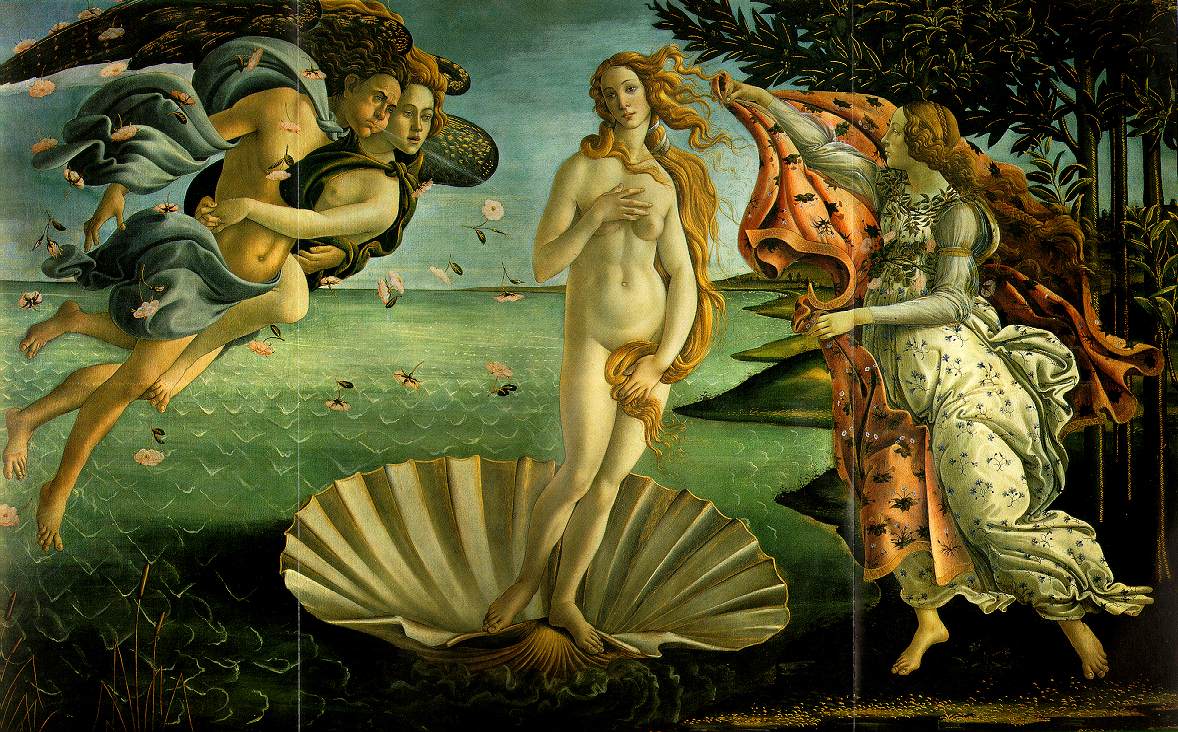
Primavera, (Spring), 1478, is one of the most famous of Botticelli's paintings but you must know Birth of Venus, 1485, that has many reproductions and has been used by some artists as a source of parody or inspiration.
The beauty of both is what first catch the attention. But there is more.
I found Madame Pickwick Art's Blog where there is a very good article about this painting and
you can refer yourself to it to watch details and learn a little more about this painting or just enjoy what you see. Paintings depicting human body can be appreciated even without knowing theirs historical and the iconographical aspects.
As I said some posts ago I'm still having some back problems and must stay away from the computer.
It's being hard to fix attention.
Hope you like Botticelli.
(as always click at the image to enlarge)

wallpaper Van Gogh and Paul Gauguin working together in Arles

wallpaper wallpaper wallpaper wallpaper


Left: The Dance Hall in Arles, 1888, Van Gogh
Right: The Arlesiénnes, 1888, Paul Gauguin

These are the paintings that Gauguin and Van Gogh did together during Gauguin visit at Arles.
It is amazing how Van Gogh did this work in a very different style as if it was a stained glass:
"This painting seems to show an evening at the Folies-Arlésiennes, a dance hall on Boulevard des Lices. Gauguin's influence is clear as Van Gogh scrupulously applies the principles of synthesism and cloisonnism developed by his friend at Pont-Aven. The reference to Japanese art is also evident, with the unusual elevation of the horizon, and in the strange, decorative foreground where the curves and counter curves of the hair are dominant.
The multitude of characters, the variety of their style of clothes and the way they overlap, skilfully portray a feeling of crowdedness and saturation. The portrait of Madame Roulin on the right, who alone turns to look at the spectator, seems to express a claustrophobic terror. In Gauguin's Arlésiennes, two female characters also express anxiety and anguish.
To escape this latent anxiety, the two men went to Montpellier on 16th or 17th December to visit the Musée Fabre. The arguments that followed highlighted their aesthetic disagreements more than ever. As a result of this day out, their separation became inevitable, and Gauguin prepared to leave."

No matter what is said when I look at Van Gogh painting I like it and can even find some peace. I would love to see the original.

Test from the Musée D'Orsay site.

wallpaper Suzanne Valadon model and artist helps seeing the difference among impressionists

wallpaper wallpaper wallpaper wallpaper


Suzanne Valadon started modeling for impressionists at a very young age following her mother's steps but she did fight not to be stigmatized and treated like a whore like her mother. She became herself a painter and her son Maurice Utrillo is a known artist.
She modeled for Degas, Renoir, Puvis de Chavannes, Toulouse-Lautrec and others.
I didn't know it was her at this work by Toulouse Lautrec, The hangover, 1888 and another Lautrec's work I like, The Laundress, and published here.
By looking at the way the impressionists portrayed her what is striking is that it is possible to see the different approach of impressionists. Too much is said about what impressionists have in common and few about every artist uniqueness. I will just publish the Lautrec today because I really like this work and leave the others for another post.

wallpaper Pablo Picasso the blue period and portrait of Gertrude Stein

wallpaper wallpaper wallpaper wallpaper


Right: The Blind Man's Meal, 1903, by Pablo Picasso
Left: Gertrude Stein, 1905–6, by Pablo Picasso


The Blind Man's Meal is part of the blue period, 1901 until 1904, a phase where Picasso's work shows loneness, abandonment, desolation and sorrow in a very deep way using all hues of blue.
After settling in Paris in 1904 he started changing his colors and motifs.
Gertrude Stein, the American poet, used to gather people on Saturdays at her home and many of the intellectuals used to attend to discuss and have fun.
This is the story of the portrait of Gertrude Stein:
In her book The Autobiography of Alice B. Toklas (1932), Stein described the making of this picture: "Picasso had never had anybody pose for him since he was sixteen years old. He was then twenty-four and Gertrude had never thought of having her portrait painted, and they do not know either of them how it came about. Anyway, it did, and she posed for this portrait ninety times. There was a large broken armchair where Gertrude Stein posed. There was a couch where everybody sat and slept. There was a little kitchen chair where Picasso sat to paint. There was a large easel and there were many canvases. She took her pose, Picasso sat very tight in his chair and very close to his canvas and on a very small palette, which was of a brown gray color, mixed some more brown gray and the painting began. All of a sudden one day Picasso painted out the whole head. I can't see you anymore when I look, he said irritably, and so the picture was left like that."
Source: Metmuseum